Anasayfa »
Phakic Lens Surgery – Intraocular Lens ICL
Phakic Lens Surgery
(Implantable Collamer or Interocular Phakic Lens)
Phakic Lens Surgery – Intraocular Lens ICL
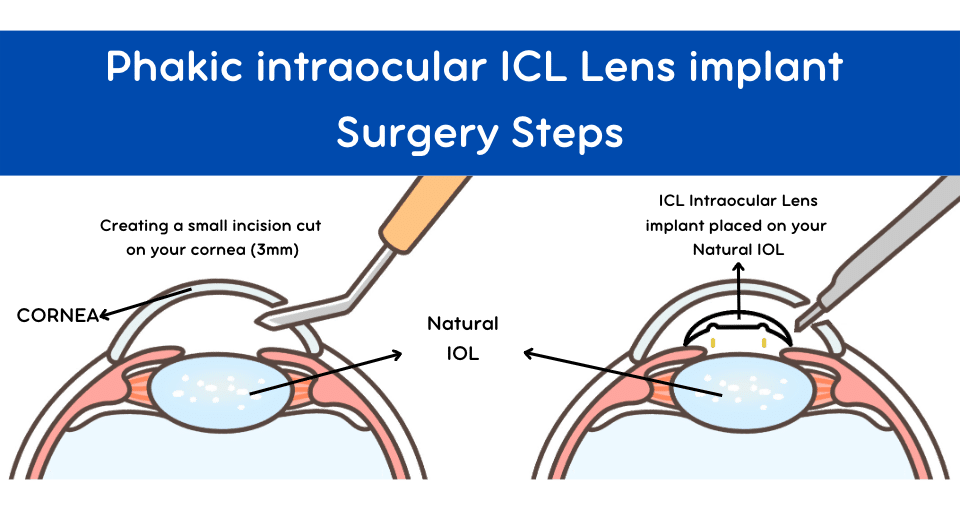
It is generally applies to patients who have a high number and are not suitable for Laser Eye Surgery. It is a procedure that corrects especially high myopia, hyperopia (far)and astigmatismeye defects. After all, the intraocular lens (ICL) is a colamer implant. In other words, it is a permanent lens. Phakic Lens Surgery means that the natural lens of your eye is not remove. Lenses are made of collagen material known as colamer. In particular, its function is similar to that of conventional contact lenses. In particular, intraocular lenses focus light properly on your retina. Thus, it works with your existing lens to correct refractive errors.
Who is eligible for Phakic Lens Surgery?
Patients between the ages of 21-45 who use high prescription glasses or contact lenses are eligible for Phakic Lens Surgery. It is among the best candidates for surgery. In addition, if your eyes are not suitable for laser surgery due to various medial obstacles, you may be a good candidate for ICL. (For example, if your corneal thickness is not suitable)
ICL Surgery is a very effective and permanent method for Keratoconus Patients whose over 35 years old and not suitable for laser surgery.
If you have Keratoconus Disease that has stopped progressing and you want to get rid of your glasses or eye defects, you can contact us for more information.
Generally, the patients who are suitable for this surgery are young patients. Especially for Phakic Lens Surgery, the age range of 21 to 45 is suitable. Although Intraocular Lenses do not correct Presbyopia reading vision problem that starts after the age of 45. After the age of 45, patients with ICL Surgery can see up close by using close glasses like everyone else. In addition, a complete eye examination including various eye tests is require before treatment.
Which refractive errors can be eliminate with Phakic Lens Surgery?
Compared to laser eye treatments, phakic lens surgery can safely and effectively correct hyperopia, myopia and astigmatism refractive errors.
Especially in refractive laser surgery, patients with myopia, astigmatism and hyperopia have upper diopter limitations. However, these upper limits are quite high in ICL surgery. Therefore, if your eye numbers are not suitable for laser eye treatment, phakic lens surgery may be a good alternative for you.
Does Corneal thickness important?
Especially in phakic lens surgery, your corneal thickness does not matter as in Laser Eye Surgery. On the contrary, recovery after these surgeries is fast as in LASIK laser eye surgeries. Another advantage of phakic lens surgeries is that the lens place in your eye can be remove in the future. Therefore, although most people will not need to have their lenses removed, the possibility is comforting for patients. A patient who has had this surgery is also protected from ultraviolet (UV) rays.
What is the Phakic Lens Surgery process?
Surgery takes approximately 20 to 30 minutes per eye. Your doctor will keep you in the recovery room after surgery to make sure that the artificial lens that is place in your eye is properly inserted. And for a few hours, it closely monitors your eyes and you can go home. Your eye surgeon will give you to use antibiotic eye drops for about one week and topical steroid eye drops for two to four weeks.
Especially Phakic Lens Surgeries are in the outpatient class and you can leave our hospital the same day after the surgery. The next day, you have to come for the control. You will need to have your check-ups one and 6 to 12 months after the surgery.
What is the Success Rate for Phakic Lens Surgery
It shows that ICL Surgeries are more effective in treating individuals with higher dioptre of Myopia, Hyperopia and Astigmatism.
Phakic Lenses are consider a suitable alternative for patients who want to correct high-grade refractive errors. However, if your eyes are suitable for refractive laser eye surgery, phakic surgery is not preferred. Because Laser Eye Surgery is a more comfortable and more economical solution for patients.
Which Phakic Lens should be preferred for surgery?
Most preferable ICL Lens manufacturer is STAAR Surgical. STAAR Surgical is FDA approved ICL lenses. EVO/EVO+ Visian Implantable Collamer Lens (ICL) for the correction of myopia and myopia with astigmatism.
EVO Lense is a biocompatible implantable lens is design to be use in Phakic Lens Surgery for patients ages 21 to 45 for high refraction errors.
ICL lenses price range is higher than Cataract IOL lenses. There for Phakic Lesn Surgery price range is high than Cataract Surgery prices. For more price information about ICL surgery please click the link.
Useful Links
Our Expert Eye Surgeons, Laser Eye Surgeries. Sensitive Profile Patient Program. Intraocular Lens ICL Surgery(FDA). Cataract and Lens Replacement Eye Surgeries. Keratoconus Cross-Linking Surgery. Blepharoplasty Aesthetic Surgeries. Dry Eye Syndrome Treatments. Periodic Eye Examinations.
Frequent Ask Questions about Phakic Lens Surgery
How much does ICL surgery cost?
The cost of ICL surgeries is higher than cataract surgeries due to the cost of the Lenses uses. STAAR Surgical ICL Phakic lenses, which are the most effective in the world and the patients are most satisfy with. STAAR Surgical Lenses generally uses in Smart Laser Eye Center. Cost per eye is apply in Phakic Lens surgeries. Costing depends on several variables, including diopter correction and the type of lens use. For more pricing information please click the link..
How long do ICL surgery take?
The ICL surgery procedure is perform on both eyes simultaneously and takes approximately 45 minutes.
At what age can I have ICL surgery?
ICL surgeries are generally performed on patients between the ages of 21 and 45. Patients over 45 years of age with Presbyopia reading vision difficulties cannot benefit from ICL surgeries. ICL Phakic Lenses are use to eliminate high prescription Myopia, Astigmatism and Hypermetropia refractive errors that are not suitable for laser eye surgery.
How painful is ICL surgery?
Since local anesthesia and a mild sedative are applies before the ICL surgery, you will not feel any pain, discomfort during the procedure. It is not different from laser eye surgery.
Your Expert Eye Surgeons

Education Information:
After graduating from primary school in Trabzon, Dr. Ofluoglu. He completed secondary and high school in Istanbul. He graduated from Istanbul University Cerrahpasa Faculty of Medicine in 1987. He successfully completed his ophthalmology residency at the Medical University of Vienna, Austria. He received his specialization equivalency in Turkey from Istanbul University Capa Faculty of Medicine . He worked as an Ophthalmologist at Taksim German Hospital between 1997-2014 as an ophthalmologist.Work experience:
German HospitalGalata Medical AcademyCertificates, Memberships, Scientific Publications:
- Articles Published in International Refereed Journals (Sci&Ssci&Arts And Humanities)
- Traenenwege from Die Endeskopie Der Ablrite. Akuchar, P. Novak,
- Ofluoglu FJ: Steinkogler. Spectrum Der Augenheikunde (1985)
- Volumersatz Der Orbita Myth Bioplastic. FJ Steinkogler, A. Kuchar,
- Novak, A.Ofluoglu Spektrum Der Augenheikunde
- Turkish Ophthalmology Association
- European Society Of Cataract And Refractive Surgeons
- American Society Of Cataract And Refractive Surgery
Specialized Treatments and Surgeries:
- Retractive Laser Eye Surgery: iLASIK (Femto Lasik), LASIK, LASEK, TransEpithelial PRK (NO TOUCH) and SMILE
- Cataract Surgery (Smart Lens Surgery)
- Keratoconus Treatments – Cross-Linking Surgeries
- Pterygium – Eyelid (Bird Wing) Surgery-
- Dry Eye Disease and Treatments
- Strabismus Treatments
- Glaucoma- Glaucoma Eye Pressure Treatments
- Diabetic Retinopathy – Treatments for Diabetes-Related Eye Diseases
- Macular Degeneration Disease Treatments
Foreign language:
- English
- German
Medical University of Vienna
35 Years of Experience
>35.000 Surgery
Patients Reviews
Definitely avoid low cost ICL Surgery
You may think that an inexpensive ICL surgery is right for you. This might be fine if you're buying a cheap TV, but it's not worth the gamble with your eyesight. But as you know, having cheap eye surgery means sacrificing technology, physician quality, medical care and sterile conditions, and most importantly, taking risks. The issues that fall on a patient who wants to have ICL surgery and should pay the most attention; The hospital with the latest technology in cataract surgery and imaging devices, a sterile environment, and an experienced doctor and clinical team should be selected. We would like to remind all our patients that they only have two eyes and that the most important and most sensitive organ is your eyes.
None of these things are more important than your eye health, and we do not compromise on quality and cutting-edge technology. We offer you our prices in a very understandable, fair and affordable way.
There are no hidden costs in our pricing. We make ICL Surgery affordable for you.